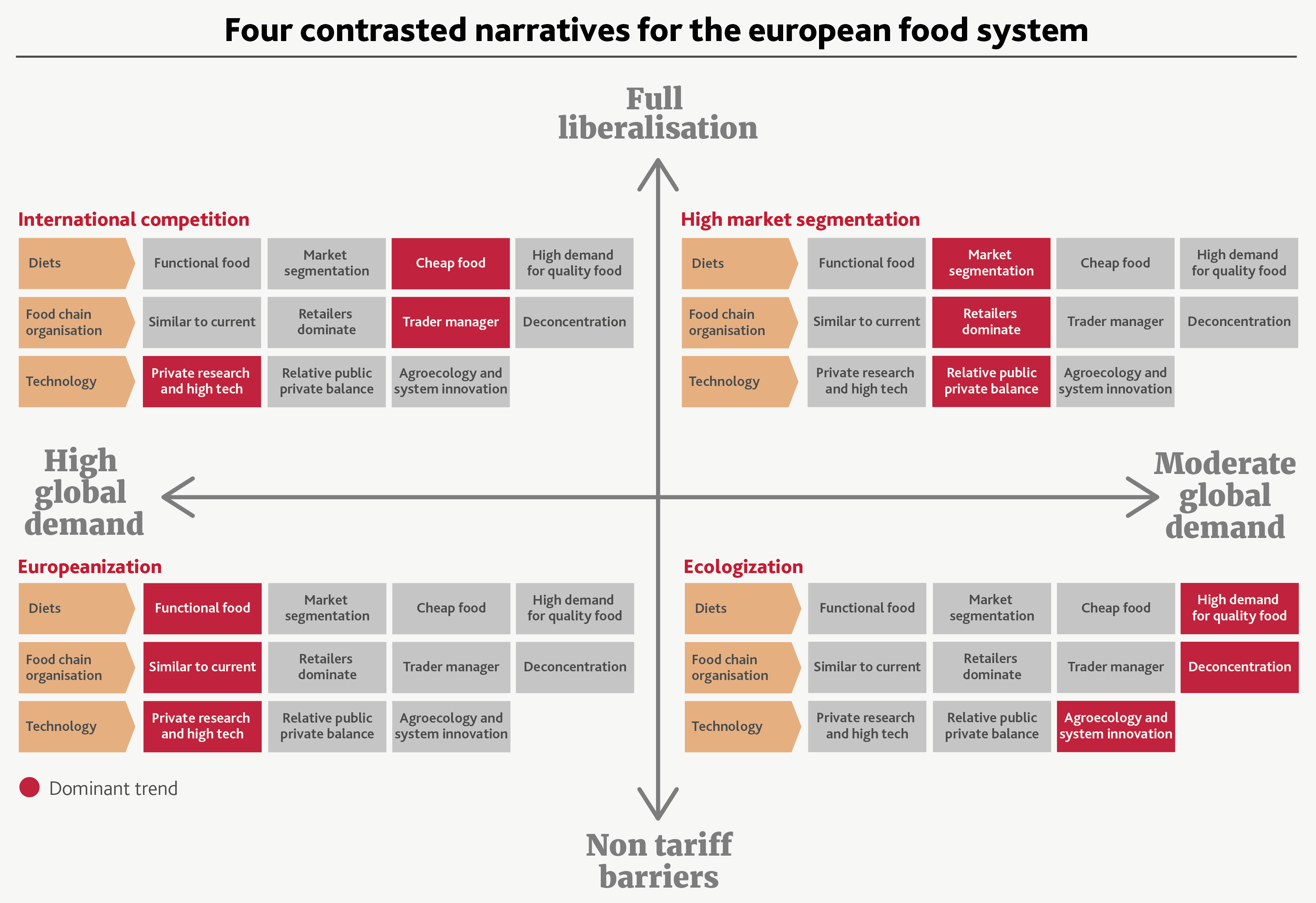
Narrative 1: International Competition
This narrative focuses on an increased liberalization of world agricultural markets and strong internationalization of value chains. There is an increasing competition with new global players from emerging countries (often more competitive), while agricultural prices become more and more volatile. World demand for food products is rising, leading to relatively high prices. At the same time, the majority of EU consumers favour low prices foodstuff, taking health and environmental issues as second order issues (the market share of organic products in the EU remains marginal under this narrative). Technological development in the agricultural sector is mainly driven by the private sector and geared towards productivity gains through yield increases (resilience or mitigation with respect to climate change impacts remain secondary). Alternative strategies for rural development or production differentiation are only partially maintained, except in very specific circumstances (for example in mountainous or "high natural value" areas).
Narrative 2: Europeanization
This narrative focuses on the assumption of a demand that is highly focusing on safety regulation and taking into consideration (to a lesser extent) environmental issues. The level of stringency of public standards on health aspects and on certain environmental aspects (mainly related to climate change) are therefore strongly reinforced and most public standards initially introduced in Europe are introduced as non-tariff barriers in free trade agreements (mainly under the pressure of the civil society). Production costs thus become relatively higher in Europe, leading to a loss of competitiveness that can only be compensated by public subsidies and leading to an orientation of the European agri-food system primarily aiming at the domestic market. European products now have a good reputation in terms of sanitary quality within this scenario, they continue to be exported to niche markets. Food chains are dominated by downstream players, retailers and food processors, acting on an even more global scale. The research and innovation system is dominated by the three biggest players in agrotechnology, but they tend to invest less in the European market (producers have access to less efficient genetic material and fewer molecules) as the new regulatory constraints is making it less attractive than in the past. Research and innovation are focusing on precision farming and big data-based solutions (satellite data, private data, etc.).
Narrative 3: Ecologization
This narrative is based on the assumption of a very high level of requirement by the consumers in terms of food security and sustainability, while the level of world food demand is slightly lower compared to the present level. Imports into Europe are governed by non-tariff rules based on clearly defined sustainability criteria, in line with civil society protests over trade liberalization. At the same time, global demand for raw agricultural products is stabilized at a moderate level, following a decline in demand for animal products and stronger regulation of biofuels. The market share of organic products and other high quality certified products reaches 20% and the demand for animal protein is decreasing in favour of an increase in the demand for vegetable proteins. Supply chains are smaller, partly reducing competition between European countries as well as price volatility and facilitating the bargaining power of producers within value chains. The public sector plays an active role in guiding the European agri-food system towards greater sustainability, by heavily funding agri-ecologically oriented research and regulating imports on the basis of sustainability criteria.
Narrative 4: High market segmentation
In line with current trends, the European market for agricultural products is highly segmented in this narrative, with higher private standards within a fully liberalized market where public standards tend to weaken. Retailers offer a wide variety of products ranging from cheap food to high quality certified products that they sell at a higher price, sometimes in the same store, sometimes through specialized subsidiaries. Consumption patterns are highly individualized but the overall demand for quality food is high and continues to grow. With large farms in Eastern European countries producing with low labour costs, producers in the old Member States are more strongly focusing on producing quality food, with consequences in terms of unequal distribution of environmental degradation within the European area. Research & development focuses mainly on product improvement rather than innovation in production systems, although there is a large niche of the research which is oriented towards agroecology. In this segmented agricultural system, producers' strategies will consist in seeking added value either by quantity or quality; or in developing a hybrid model at the farm level, integrated into a specific territorial configuration.