
Eight months after the blockade of the Strait of Hormuz began, hopes of a swift resolution to the conflict have faded for good. Rising energy prices, which started with oil, are now spreading to natural gas and electricity. In each case, the key question is the same: how to reconcile security of supply, protection for the most vulnerable consumers and faster decarbonization in order to strengthen resilience and energy sovereignty? By prioritizing targeted aid for vulnerable consumers and support for electrification, France has taken a markedly different approach from the one it adopted during the previous energy crisis, a shift driven largely by budgetary constraints. But many challenges remain before it can deliver on its ambitions.
An entrenched crisis that now affects all energy sources
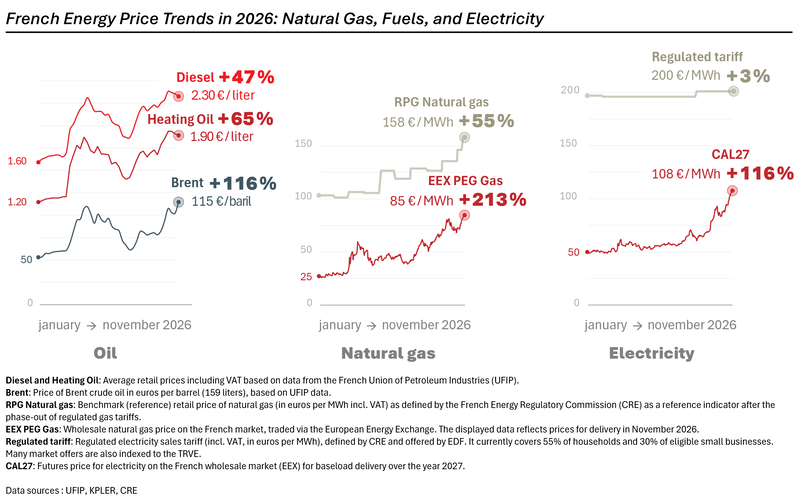
As discussed in an recent blog post (IDDRI, 2026a), the Strait of Hormuz crisis has been marked from the outset by a high degree of uncertainty about where fossil fuel prices are heading. Eight months on, the situation has clearly deteriorated, as illustrated by the evolution of energy prices in France.
- Pump prices have settled firmly above €2 per litre, with diesel peaking at €2.38 per litre in September 2026 (up 50% on January), and there is so far no sign of a return to pre-crisis levels. Heating oil has followed the same trend, rising 65% since the start of the year.
- The halt in liquefied natural gas flows through Hormuz, combined with a wait-and-see approach to refilling storage, has driven a further sharp rise in wholesale gas prices, which doubled between January and October. Household prices, meanwhile, have risen by 55%, as measured by the benchmark price set by the French Energy Regulatory Commission (CRE).
- The French electricity market, long insulated from the crisis with prices well below those of its neighbours, has now seen wholesale forward prices for 2027 double, driven by various factors1. This should have only a limited effect on consumer prices in the short term. Even so, the prospect of a further rise in the regulated tariff, expected in February 2027 after the August 2026 increase, would send a signal that runs counter to the shift towards electrification.
According to data from the tracker set up by the Jacques Delors Institute, the crisis added more than €100 billion to the EU’s fossil fuel import bill between March and September 2026 alone. On top of this, Member States have committed more than €33 billion in public support to limit the impact on consumers. 2
France rethinks its crisis response
The French government’s stance on the energy crisis has shifted markedly in 2026. During the previous crisis, from 2022 to 2024, the tariff shield introduced to hold down electricity, gas and fuel prices for all consumers. While effective in curbing the inflationary spiral, this hugely expensive scheme drew criticism for being poorly targeted, cost-inefficient and incoherent in economic, social and environmental terms (Rüdinger, 2023). What is more, the entire effort went into keeping bills down in the short term, widening the public deficit and leaving less room to fund the transition investment that would reduce vulnerability to future crises.3 As a paper from the Mobility in Transition Institute (IMT, forthcoming) shows, most of the measures currently on the table, such as cutting VAT or freezing prices across all energy sources, would replicate the same flaws.
In 2026, France has taken a different approach, informed by the lessons of the previous crisis but driven chiefly by tighter budgetary constraints. It rests on two key pillars. The first is financial support targeted at the most vulnerable consumers, at a significantly lower cost than in most neighbouring countries.4 The second is Europe’s first national electrification plan, (IDDRI, 2026b), which France published three months before the EU’s own plan. This approach is yielding encouraging results. France has recorded the sharpest rise in electric vehicle market share in Europe, with electric models accounting for more than 40% of new vehicle sales in September. Heat pump sales are following a similar trend.5
While there is still room for improvement, France’s approach shows that it is possible to move beyond the false choice between making ends meet and tackling climate change, often summed up in French public debate as the “end of the month” versus the “end of the world”. The key lies in targeted support, both to help consumers with their bills and to ensure the transition is accessible. Social leasing for electric vehicles has become a model across Europe. Low-income and very low-income households account for 80% of the deep renovations supported by the MaPrimeRénov’ grant scheme (19% and 61% respectively). The new “integrated offer” for heat pumps also aims to break new ground, with a turnkey package that combines third-party financing of the equipment, a maintenance and performance-guarantee contract, and a guaranteed price for the electricity used over three years. Finally, the launch of “electrification territories” offers a promising way of addressing, at local level, the future of energy networks as gas and heating oil are phased out.
Emerging stronger from the crisis: three challenges to overcome
France today has many strengths that could make it an “electrostate” faster than some of its neighbours, including electricity that is already decarbonized, plentiful and competitive, and an ambitious strategy for electrifying end uses. But to deliver on this potential, France must overcome three challenges.
The first is achieving a genuine step change in the rollout of electrification policies,6 which means significantly increasing the funding behind them. France’s 2026 multi-year strategy for financing the ecological transition highlights that annual investment in decarbonization would need to more than double, particularly in buildings and transport. Meeting this need calls for two complementary approaches. One is mobilizing new public funding; the other is strengthening the economic signals that make investment more attractive, starting with carbon and electricity pricing.
Closely related to the first, the second challenge is the need for renewed leadership at European level to align economic signals with an ambitious electrification strategy, starting with championing an ambitious strategic vision for the European carbon market (). The carbon market has the advantage of addressing both issues at once. It acts as a powerful lever for financing the transition (particularly the decarbonization and electrification of industry; IDDRI-Agora, 2026) and as a key price signal for triggering investment, while also strengthening the competitive edge of the countries furthest ahead on decarbonization.
Finally, with electricity prices once again at risk of rising, the third challenge is to establish a genuine electrification pact at national level, and ideally at European level. In particular, this pact should set out credible guarantees of the state’s ability to stabilize electricity prices for all consumers, by drawing on several complementary levers:
- the extension of contracts for difference to all low-carbon generation (nuclear and renewables), which is essential for passing the stable costs of this generation on to consumers;
- coherent planning of energy taxation that ensures, in line with new EU guidance, that electricity is taxed less than fossil fuels. This would also address fears of a potential “tax trap”, in which electricity taxes are raised in future to offset the erosion of fossil fuel tax revenues (particularly from road fuels) as decarbonization progresses (IMT, 2026);
- the introduction of an electricity social bonus as targeted cost-of-living support for vulnerable households, offsetting rising energy prices (road fuels, gas and potentially electricity) while sending a strong political signal in support of electrification;
- a reform of electricity pricing to develop demand-side flexibility, which is essential for lowering electricity system costs and consumer bills.7
Holding to this course in managing the crisis is a tricky challenge, all the more so as elections approach and pressure mounts for short-term, across-the-board measures. But this test of the credibility of transition strategies reaches well beyond France’s borders. At a time when electrification is steadily emerging as one of the pillars of the global energy transition, and is expected to be central to discussions at COP31 in Turkey, the success–or failure–of this strategy will be closely watched far beyond Europe. Against a backdrop of permacrisis and heightened geopolitical tensions, France and Europe face a choice: embrace the electrostate path, or leave it to others and be ever more subject to a balance of power dictated by fossil fuel states.
- 1
Thanks to plentiful nuclear and renewable generation (hydro, solar and wind), the French electricity market proved highly resilient to rising gas prices in the first half of 2026, with 2027 contracts trading at €50-55/MWh. The price rise stems in particular from the impact of heatwaves on hydropower output (down 30% on the previous year) and on the availability of nuclear plants, which have also been affected by delays to maintenance work. Together, these factors reduce the system’s flexibility in the short and medium term, raising fears of greater reliance on gas-fired power plants, whose generation costs have doubled.
- 2
Monthly energy data from France’s energy and environment statistics service (SDES) show that the cost of petroleum product imports rose by €6.6 billion between January and August 2026 compared with the same period the previous year. Public support spending, meanwhile, stood at €1.4 billion as of mid-September.
- 3
During the 2022-2024 energy crisis, IDDRI made a simple proposal: “1 euro = 1 euro” rule, under which every euro spent helping consumers with their bills would be matched by a euro spent accelerating transition policies.
- 4
According to the Jacques Delors Institute tracker, public support provided in response to the crisis has so far totalled €1.4 billion in France, compared with €4.1 billion in Germany and €12 billion in Spain, where it takes the form of untargeted measures (cuts to VAT and other taxes). For a driver covering 15,000 km a year at 6 litres per 100 km, France’s two €100 payments for “high-mileage drivers” amount to a discount of 22 cents per litre over the year. For someone driving just 8,000 km a year for work, the discount rises to 40 cents per litre.
- 5
According to market data published by the heating and cooling industry federation Uniclima, sales of air-to-water heat pumps rose by 20% in the first half of 2026, while sales of air-to-air models were up 44%. Gas boiler sales, by contrast, fell by 23% compared with the first half of 2025.
- 6
By way of illustration, France’s target for electric vehicles (EVs) to account for 66% of new registrations in 2030 (and 15% of the vehicle fleet) implies selling around 1 million EVs a year by 2030, compared with 327,000 in 2025 and probably more than 500,000 in 2026. For heat pumps, the French strategy targets 9 million units in 2030 (up from 3.5 million today), which means installing just over 1 million a year, compared with 182,000 in 2025 (excluding air-to-air models). Across the economy as a whole, the third multi-year energy programme (PPE3) sets out a trajectory in which electricity consumption rises by around 10-15 TWh a year (compared with an increase of barely 2 TWh in 2025), equivalent to the output of two EPR reactors every year.
- 7
Based on the proposal put forward by Avenirs énergétiques, this reform could, for instance, double the number of off-peak hours and halve the number of peak hours, moving from the current 8 off-peak and 16 peak hours to 16 off-peak and 8 (or even 6) peak hours, concentrated on the morning and evening demand peaks. In return, the price gap between peak and off-peak hours could be widened so that smart control of shiftable demand becomes the norm.
