
Annual Report 2025-2026
Climate, economic, and geopolitical crises are fueling uncertainty and shifting strategic priorities toward short-term security concerns, often at the expense of transformative change. Yet the transition to a low-carbon, resilient economy remains a credible solution, provided we rethink forms of cooperation and reconcile security imperatives with a long-term vision.
Read Sébastien Treyer's editorial
Focus
IDDRI co-leads the T7 2026 initiative amid growing challenges to multilateralism
As international cooperation is increasingly being undermined by the emergence of power dynamics as the only way of making “deals”, IDDRI identifies opportunities to revitalize cooperation to better manage the physical, economic and social interdependencies between countries, through forums dedicated to sustainable development (climate, biodiversity, high seas, etc.) as well as economic cooperation forums such as the G20 and the G7, seeking to connect geopolitical, economic and environmental dimensions. In 2025, IDDRI co-led the energy-climate task force of the G20 Think Tanks Engagement Group (T20) under the South African presidency and, together with ECFR, assumed overall leadership of the G7 Think Tanks Engagement Group (T7) for 2026 under the French presidency. IDDRI chose to carry out this work by opening the forum to experts from non-G7 countries, thereby fostering crucial dialogue with key partners. The task forces coordinated by IDDRI addressed five key issues relating to the coordination of industrial policies in the context of macroeconomic imbalances and to the renewal of partnerships for international development. The T7 Solution Papers were presented in March 2026, ahead of wider dissemination and public debate, in preparation for the G7 summit in Évian in June 2026.
Key achievements
Ten years of the Paris Agreement: a review and outlook for its implementation
Green industrialization in Africa: the dialogue is widening
COP17 Biodiversity: IDDRI’s proposals for the Global Review and financing
Europe: what policies are needed for sustainable competitiveness?
Transformation of the energy sector
Agriculture: key approaches to minimizing strategic dependencies
Biogas: shedding light on the tensions surrounding support policies
Transformational adaptation is gaining momentum
What strategy should be adopted to promote environmental issues?
IDDRI Team
The IDDRI team comprises 52 staff members. The institute’s researchers teach in a number of master’s programmes, including at Sciences Po’s School of Public Affairs, School of International Affairs, School of Management and Impact, and School of Journalism.
PARTNERS
Partnerships that support our mission
Key figures
16,000
newsletter subscribers, 7,000 weekly readers
500,000
visits to www.iddri.org
24,000
Linkedin followers
9,000
IDDRI podcasts listeners
BUDGET AND TRANSPARENCY
Budget
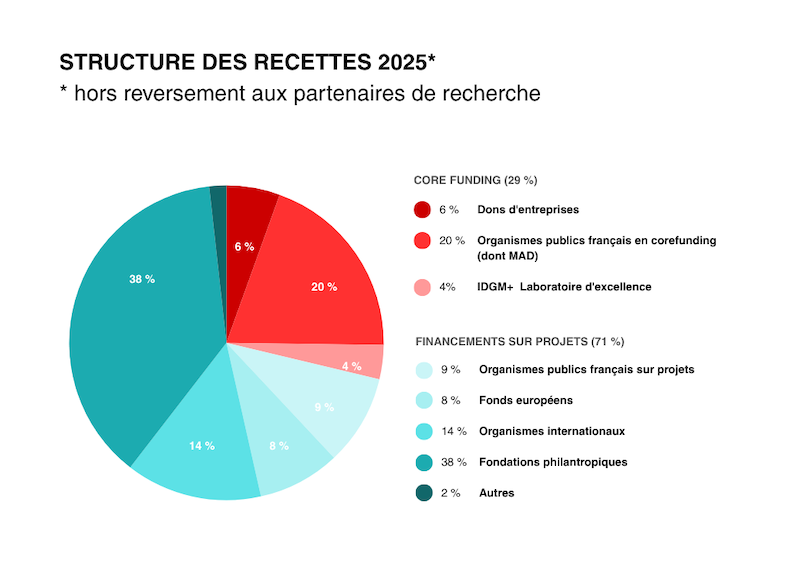
IDDRI has received support from its key partners, who have renewed their annual core funding for IDDRI's activities as a whole, i.e. 29% of the total budget. This funding enables the implementation of the research program defined by IDDRI's teams in accordance with its strategic guidelines and approved by the Board of Directors. More information.
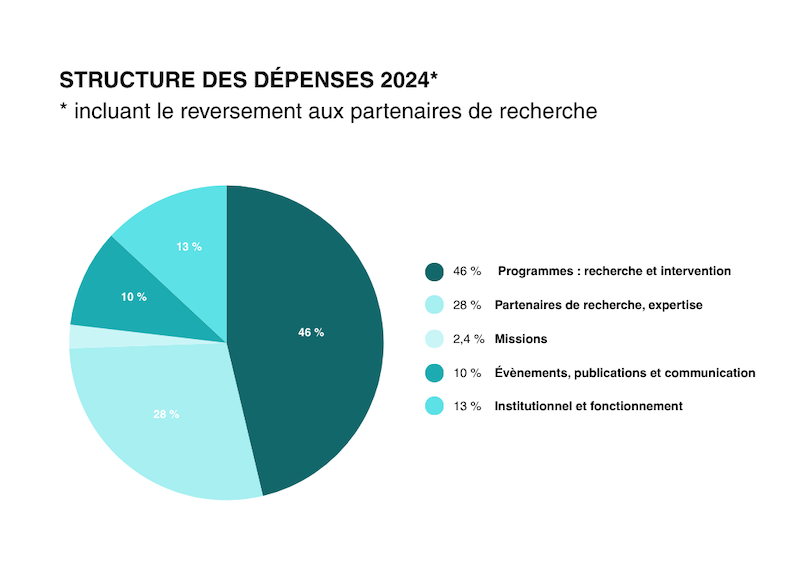
Expenditure is divided between research programmes carried out by IDDRI and its scientific partners, communication activities, and support, cross-cutting functions, structural and operational costs. More information.
Governance
IDDRI is a public-interest foundation. Its Board operates under the supervision of a Government Commissioner, appointed by the French Ministry of the Interior, to ensure compliance with this legal status. The Board, IDDRI’s main decision-making body and responsible for approving IDDRI’s programmes, has been chaired by Michel Eddi since 2019, with Jean Jouzel serving as Honorary Chairman. The Strategic Advisory Council (SAC), which supports the Board, brings together representatives from a range of stakeholders to help ensure the relevance of the institute's work programme and intervention strategies. This is also the case for the Scientific Council, which is similarly multidisciplinary and helps identify emerging scientific challenges and potential areas for future research.