
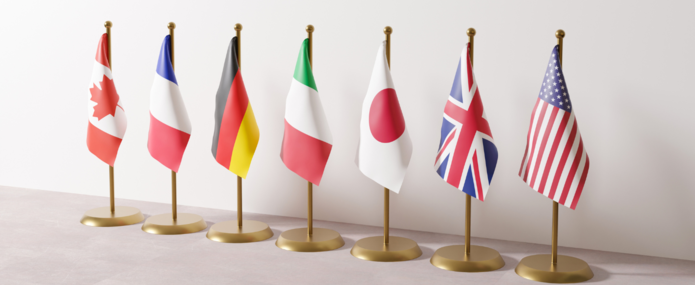
What the G7 could deliver amid geopolitical tensions, open conflicts and frictions among members has been unclear since the beginning of its French Presidency. Given the US position, some topics were out from the start (decarbonization or equity). Others were uncertain due to the relative US disinterest (development) or to the shared interest but profound divides across economies (global imbalances). Against this background, the discussions of the past few weeks have shown interesting convergence, including the US, on a renewed narrative for development finance, one that, if not entirely new in its elements, is finding a renewed political momentum to rediscuss the terms and respective needs of partners. Operationalization remains nevertheless fraught with challenges and contradictions that need to be embraced and addressed in the current sequence of G7 meetings and beyond.
Development finance: What are the shifts underway?
The recent weeks have been heavy on events on the future of development finance and partnerships, starting with the Paris Dialogue, the G7 Development Ministerial, the Finance in Common (FICS) special session, the OECD Conference on the future of development cooperation, Africa Forward (IDDRI, 2026a) and the Global Partnerships Conference.
This is happening in a context where the OECD Development Assistance Committee (DAC) data are showing the largest annual decline in official development assistance (ODA) since 1960: 23% in 2025 with a further 5.8% drop projected for 20261, departing from the 2003 Evian Summit or Gleneagles (2005), when leaders strongly affirmed their collective responsibility to end poverty and made significant commitments in terms of ODA increases and debt relief. This contraction brings ODA to 2015 levels, the adoption year of the 2030 Sustainable Development Agenda, even as the gulf between the amounts mobilised by developing economies and the trillions needed to meet development goals is growing.2 Together, Germany (which has become the largest ODA provider in 2025), the US, the UK, Japan, and France, all G7 countries, account for 95.7% of the total decline in ODA, with G7 countries overall still providing some 69% of DAC member countries’ ODA.3
In the face of this ODA crisis, the meetings of the past few weeks have been the opportunity for discussions in continuity with previous G7 (in particular Italy)–and the release of a Development Ministerial Communiqué showing some degree of consensus among members, which in itself is an achievement.
Countries have converged on the need for a more integrated approach to development finance, one that goes beyond ODA to allow for a fuller picture of development finance. While discussions highlighted the critical role of ODA for solidarity and accountability, its sole consideration was seen as undervaluing the broader contributions of donors and as out of step with the Compromiso de Sevilla's call to mobilize all sources of financing for sustainable development (IDDRI, 2025). In line with this, the Development Ministerial Communique “calls for an ambitious review of OECD's DAC including to better reflect private capital flows and other non-traditional forms of development finance.” Of course, the (not so new) ambition is to get real on private finance mobilization: “We intend to significantly expand the use of risk-sharing instruments, guarantees, and blended finance to crowd in private investment.”
Second, the “new” narrative proposes a shift from aid to mutually beneficial partnerships. The Development Ministerial Communique starts with “a new approach based on mutually beneficial partnerships”. It is a narrative that G7 and partners can buy into, relying on mutual benefits and mutual accountability and country ownership or “sovereignty”, in line with current priorities on security and national autonomy in decision making. Accordingly, both the Communique and the FICS discussions confirm a key role for country platforms: “We promote country-driven approaches such as country platforms as a key principle of development cooperation”.
Third, the effectiveness agenda is back with a twist. It is front and centre of the second heading of the Communiqué and stands on two legs: making every concessional dollar count and directing money where it matters most. While the aid effectiveness agenda is not new–the Paris Declaration on aid effectiveness dates back to 20054–its relevance is amplified by the current cuts in ODA. Consequently, allocation of ODA is taking a new importance. It is illustrated in the Communiqué by the focus on “needs”: “we need a more efficient and effective international development architecture; one that (…) concentrates concessional resources where they are most needed”; “We encourage all development actors to focus concessional resources where they are most needed, particularly in least developed and most vulnerable countries.”
Finally, scarce public resources make it even more difficult to tolerate fragmentation, in particular the dispersion of concessional funds from a growing range of institutions. Hence the calls for more collective action and for key actors–be they bilateral or multilateral–to work as a system. It comes back throughout the Communique: “We aim to address the fragmentation of the development system”; “We encourage collaborative approaches including between multilateral development banks, public development banks, vertical funds, and other development institutions to find synergies and areas for broader and deeper collaboration, including through mutual recognition of procedures, in close collaboration with the private sector.” Working as a system and promoting interoperability were also at the core of the FICS discussion and of its contribution to the G7.5
The new narrative is not without contradictions that need to be recognized and addressed
The Development Ministerial has opened a sequence of meetings in the run-up to the Evian Summit, including Africa Forward (11-12 May) and the Global Partnerships Conference co-hosted by the UK and South Africa (19-20 May). These meetings, the upcoming Evian Summit and G20 under UK Presidency, as well as future OECD DAC discussions provide important opportunities to address the tensions that already transpire from the new development narrative.
While ODA cuts call for joint approaches that allow for scale and impacts, there is a real risk that they create pressure to show individual results (typically to donor countries’ own domestic constituencies). In effect, truly incentivizing systemic approaches is not that easy–it requires revisiting evaluation methodologies away from single organization or country approach. It may also require stronger support to multilateral development organizations in a context where core support from DAC member countries dropped 15% in 2024, with a projected decline of 23-30% by 2027.6 In particular, multilateral development banks (MDBs) have a critical role to play in development finance (IDDRI, 2026b)–with progress made in recent years that need to be sustained given their contribution to both the investment and the solidarity dimensions of the agenda.
The path towards the operationalization of the statement on mutual benefits remains nebulous. It is notably unclear how the need to play collectively and the emphasis on donors’ own benefits can work together. It is also not obvious how the donor’s benefits will always coincide with the recipient’s. Given the power play, and discussions underway in the G7, it is likely that the emphasis be put on supporting donor countries’ own objectives, as illustrated by the comeback of tied aid, or for that matter of industrial policies that focus on developed and emerging countries own economic development rather than on meeting the rising expectations of partner countries to develop their own capacity. Showing good faith on this, notably through policy coherence, will be critical–it probably starts with reiterating and broadening the commitment to untied aid and acknowledging the need for mutually beneficial partnerships in key value chains (such as those involving critical minerals, as highlighted in the related T7 Solution Paper, [2026], an important area of discussion of the current G7). Doing so as part of the G7 would go a long way to build credibility of the new narrative.
Finally, the shift to new development partnerships that go beyond aid raises several challenges, including addressing the policy silos to bring different policy and other communities together (including the private sector) and ensuring policy coherence (across aid, trade and investment policies). Fundamentally, one may also wonder how to maintain the solidarity objective of the agenda towards the most vulnerable countries and communities. The Communique and direction of discussion support a dual mandate for development finance–one of investment where the "partnerships" logic applies, and one of solidarity in contexts where private finance cannot be raised and where ODA remains the main tool. However, the cuts in ODA undermine the second half of the agenda if such reductions are not combined with clear prioritization criteria, which so far is not the case. Indeed, the Communiqué provides a long list of priorities that are not likely to be covered by the limited available funds. A lack of consensus among countries on a vision for what concessional finance should work towards (in line with the development priorities of recipient countries) risks reinforcing ODA dilution, threatening in fine the effectiveness and solidarity objectives.
There are still important missing components to underpin a credible development agenda for the G7, that would feed into future G20s and bring along the broader range of DAC donors. They relate to the development community itself (allocation criteria), as well as to the coherence of the new approach with broader policy agendas, including some addressed in the G7, such as trade and critical minerals. The important sequence of meetings ahead under the G7 French Presidency and the upcoming G20 under UK Presidency provide opportunities to make a significant and coherent progress on development finance and connect relevant processes beyond the G7 and G20.
