
COP30 on climate was also intended to be the ‘COP of adaptation’ (in addition to the ‘Implementation COP’). The adoption of a set of indicators to monitor global adaptation progress was eagerly awaited, as a way to measure progress towards the Global Goal on Adaptation outlined in the Paris Climate Agreement. Although the list that was ultimately adopted falls short of the initial ambition and was deemed unacceptable by several countries, it delivers an official outcome to a process that was launched several years ago, and it should provide a useful common basis for the Parties in their respective national contexts and with a view to strengthening the exchange of experiences. This blog post analyses the challenges of operationalizing these indicators within the national-level adaptation efforts.
The result of a long process
As climate risks increase, adaptation efforts remain insufficient, as highlighted once again this year in United Nations Environment Programme (UNEP)’s Adaptation Gap Report. COP30’s Brazilian Presidency had announced its ambitious to raise this issue high on the negotiating agenda. In the end, the Parties adopted a commitment for tripling adaptation funding by 2035 (albeit without any reference dates) and a list of indicators to measure adaptation progress. This list is the result of a long process initiated by the 2015 Paris Climate Agreement, which established a Global Goal on Adaptation to ‘enhance adaptive capacity, increase resilience and reduce vulnerability to climate change, in order to contribute to sustainable development and ensure an adequate response to adaptation.’ In order to make this goal operational, a two-year work programme was launched at COP26 in 2021, which led to the United Arab Emirates (UAE) Framework for Global Climate Resilience, which in turn initiated the UAE and Belém Work Programme on Indicators.
This complex architecture is a direct reflection of the challenge of establishing a coherent and relevant set of adaptation indicators at the global level. This is a methodological challenge that has long been the subject of scientific and political debate. At the global level, indicators and associated metrics have so far been limited to a single quantitative dimension, i.e. the economic dimension, leaving aside numerous dimensions that are more difficult to quantify but do play a key role in adaptation. The definition of these new indicators should therefore facilitate the assessment of collective progress at the international level in terms of adaptation, particularly in view of the second Global Stocktake scheduled for 2028 under the Paris Agreement. Such an assessment is essential in order to monitor the adequacy of adaptation efforts and their effectiveness in reducing risk and vulnerabilities, as well as to identify gaps so that efforts can be realigned if necessary.
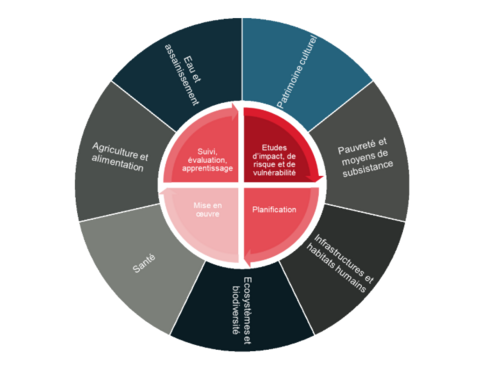
Figure. Thematic and process targets of the Global Adaptation Goal defined by the UAE Framework for Global Climate Resilience
Over the past two years, 78 experts appointed by the United Nations Framework Convention on Climate Change (UNFCCC) under the direction of the Parties have carried out considerable work to define several thousand indicators and then reduce them to 100. In the end, in a tense atmosphere, the Parties adopted a list of 59 indicators in Belém (see the list), which omits certain topics (such as transboundary risks) and also differs significantly in its wording from the experts' proposals. The final agreement prevented a complete failure on this issue, but the result remains unacceptable to many countries, which have expressed their dissatisfaction with the way the negotiations were conducted. The countries also agreed to continue working on these indicators in order to provide guidance on their use and make them operational.
A global-level issue, which raises concerns
While adaptation has long been perceived as primarily a local issue, COP30 succeeded in defining an initial common basis for all Parties to measure adaptation progress despite specific contexts–a tension that was partially resolved by many Parties’ reminders that using these indicators for country reporting remains voluntary and should not create new obligations. While this allows each country to decide which indicators are most relevant in its context, such flexibility will limit the possibility of aggregating national indicators to provide an overview of adaptation progress. This flexibility in the interpretation of indicators was even amplified during the final stretch when the Parties themselves renegotiated certain indicators.
The challenge now for the Parties will be to refine these indicators and see to what extent they can contribute to triggering adaptation efforts, a task that could be addressed in particular by the Belém-Addis Vision for Adaptation, a two-year policy alignment process (from COP30 to COP32) launched to provide guidance on how to make the indicators operational. Furthermore, if this framework is to become the benchmark for measuring adaptation efforts between now and 2027, countries will need appropriate resources (financial, but also in terms of institutional and technical capacity) to be able to report on these indicators, as the current list does not account for the burden inherent in data collection, the creation of missing data and the associated reporting process.
What role for indicators in adaptation planning and implementation?
An international reporting framework that should not replace national priorities
These indicators are intended to serve as a basis for countries' reporting on adaptation under the UNFCCC. However, they are mainly quantitative, and therefore dependent on databases that remain incomplete in a number of countries (Biesbroek et al., 2025), and which will at best reflect national averages rather than the diversity of local situations within a given country. Furthermore, some countries have expressed concern that these indicators could influence the allocation of adaptation funding–for example, from international donors–and thus overlook other national priorities. In theory, these indicators should primarily help to provide a snapshot of adaptation efforts at a given moment in time. Their objective is therefore not to replace national processes and priorities in terms of planning, implementation and evaluation systems for adaptation, but to provide a working basis that, over time, will give an indication of the major trends and developments (positive or negative) in adaptation at the global level. In other words, they will help us know ‘where we are’, but do not tell ‘where we should be going’–the answers to this question being necessarily different from one country to another.
A basis for engaging in discussions at national level and between countries
However, the existence of certain indicators can help to shed light on grey areas in national planning, implementation and monitoring/evaluation. For example, they may prompt questions such as: if an indicator cannot be measured, does this mean that it is not relevant in the national context, or does it reveal a gap in data availability, monitoring capacity or planning? The framework adopted in Belém could thus, in some cases, lead to more ambitious national adaptation efforts. It could also encourage and facilitate the sharing of experiences between countries (Beauchamp et al., 2024), for example on how certain issues are addressed, based on the gaps identified, and thus promote international cooperation by identifying countries that have adopted particularly interesting practices in certain areas that others could draw inspiration from, including by promoting knowledge and practice-sharing among countries.
The need for complementary qualitative approaches
Finally, certain aspects of adaptation, including those relating to its implementation conditions, such as governance or civil society engagement, remain difficult to quantify, albeit crucial. The complexity of national issues risks being further obscured by the fact that the final list focuses on a set of indicators that is even smaller and less comprehensive than those proposed by the experts. Furthermore, as explained above, the indicators do not measure the gap between what has been achieved and what would be desirable. However, one of the crucial issues highlighted by the IPCC is to define resilient development trajectories by reconciling views, interests and values that may diverge among multiple stakeholders (IPCC, 2022). Indicators should therefore be developed that are both qualitative and based on the co-construction of these shared visions of the challenges and solutions, in order to complement the Belém adaptation indicators.
IDDRI has long been advocating for the development of such methodologies, demonstrating that they could be useful in making the Global Adaptation Goal more operational (Magnan, 2023). Structured expert judgement methods, such as the GAP-Track approach developed by IDDRI, can help bridge the gap between the local, national and global levels, with already convincing results (Magnan et al., 2023). By extending the notion of experts, it is possible to include the experiential knowledge of multiple stakeholders (populations, decision makers, the private sector, etc.) in order to co-construct a shared vision of the issues and define possible responses (Magnan et al., 2025). In other words, these methodologies promote both diagnosis (‘where are we now?’) and the co-construction of responses (‘where do we want to go collectively?’). It remains to be seen how these complementary approaches can be combined with the results of the indicator-based approach; on this point, there is currently no debate within the UNFCCC.


