
Context and issues
Because climate change is already a reality worldwide and science warns against a more precarious future for ecosystems and societies, deeply investing in adaptation is both inevitable and an urgency. Efforts towards enhancing adaptation policy, implementation and finance are recognized, but there is a growing consensus that such efforts are not enough and that the necessary shift in scale on adaptation has not happened yet. However, where we stand more precisely on adaptation efforts remains unclear, from local to global levels.
At the global level, for example, understanding the adequacy and effectiveness of current adaptation strategies and interventions involves more than reviewing policy instruments and financing tools for a narrowed down schema of “bankable” adaptation-oriented projects. This also requires further evidence of climate risk reduction at various timescales, whether the natural and anthropogenic underlying drivers of exposure and vulnerability are considered, and whether compound cross-border and systemic dynamics are addressed. Such a multi-dimensional understanding however raises numerous methodological questions relating to the lack of quantifiable adaptation goals that can be used as baselines or targets; as well as the difficulty to identify sets of quantitative indicators that capture adaptation in a more comprehensive way, are relevant across countries, and can be informed with reliable data.
As most of the existing adaptation assessment approaches fall back into the issue of indicators and data availability, alternative approaches are needed to complement views on adaptation efforts. The Global Adaptation Progress Tracker (GAP-Track) is one of such alternative approaches.
Objectives
The ultimate goal of the GAP-Track is to inform policy processes at multiple levels. The GAP-Track methodology is based on an expert judgment method supported by a scoring system and that is framed by six overarching questions reflecting core components of adaptation (knowledge, planning, actions, capacities, evidence, and forecasting; see figure below). These components can help to understand the effectiveness and adequacy of different kinds of adaptation efforts in various systems such as socio-ecological territories, sectors, or (groups of) populations. This way, the approach promotes cross-scale applicability, flexibility, technical robustness of results and openness to a variety of resources and knowledge.
A first pilot study was conducted in 2021 for two systems, i.e. national-level case studies (Mauritius in the South West Indian Ocean and Senegal in West Africa), and with a focus on one particular Representative Adaptation Challenge, i.e. coastal adaptation.
The current phase of the GAP-Track (2022-2023) aims to scale up the assessment to 10 global-scale systems: Coasts, Cities, Mountains, Arctic, Rural areas, Transboundary ecosystems, and Health, Infrastructure and energy, Food security, and Peace. Together, these systems reflect a set of Representative Adaptation Challenges at the global level and thus provide an overview of what does adaptation look like globally across areas and sectors. Using the same scoring and expert judgment approach, its ultimate aim is to help tracking adaptation progress through regular assessments, and thus inform the UNFCCC Global Stocktake (GST) series that will operate every five years.
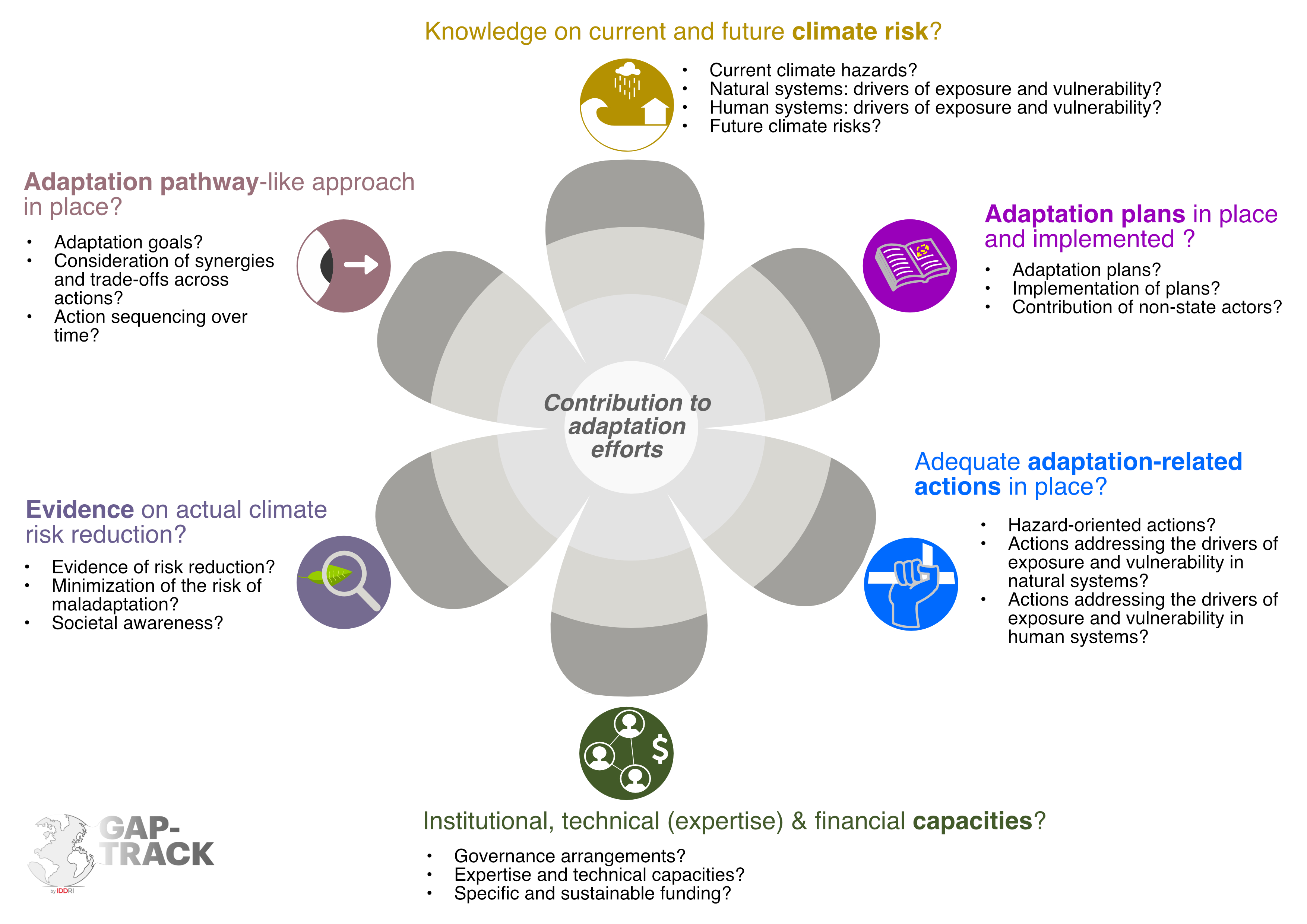
The “GAP-Track flower”. The assessment matrix of the Global Adaptataion Progress Tracker.
The Track Adapt research project aims to develop a new methodology, based on the GAP-Track monitoring system, to closely assess progress on urban adaptation to climate change. It will help build a shared understanding of adaptation challenges with local stakeholders in the cities of Cape Town and Nelson Mandela Bay (South Africa), and identify effective, context-specific adaptation pathways.
Main productions
- 2021_GAP-Track-methodological Report [PDF]
- 2021_GAP-Track final results report
- 2021_Blog: Enhancing adaptation tracking at the global level
- 2021_Scientific paper on global climate risk
- 2021_Scientific paper on mapping global adaptation
- 2021_GAP-Track case study Mauritius (2 pages) [PDF]
- 2021_GAP-Track case study Senegal (2 pages) [PDF]
- 2021 Pilot Study_Assessment matric[XLXS]
- 2021 Pilot Study_Database Mauritius [XLXS]
- 2021 Pilot Study_Database Senegal [XLXS]
- 2022_GAP-Track concept note of the global-scale application [PDF]
- 2022_Scientific paper on "Strengthening global climate adaptation research" (Science) [PDF]
- 2023_Chapter on "The added-value of expert judgment-based approaches to assess adaptation efforts"
- 2023_Scientific paper on « Status of global coastal adaptation » (Nature Climate Change)
- 2023_Scientific paper on « Global climate adaptation assessed by structured expert judgement for coastal areas » (Nature Climate Change)
- 2023_Blog on « Supporting alternative scientific approaches to assess global climate adaptation » (SpringerNature Communities)
- 2023_Blog on « Robust framework for Global Goal on Adaptation needed, no time to waste » (IIS SDG Knowledge Hub)